Quick Navigation
Table of Contents
This Marine Wire Gauge Calculator is your best friend when it comes to choosing the correct AWG wire size for any DC circuit on your boat. It evaluates current load, cable length, voltage drop limits, and marine-grade wire ampacity to ensure your wiring meets ABYC E-11 safety standards.
Let’s be honest: nobody wants to be “that guy” at the marina whose boat is known as the “local smoke signal.” Using undersized wire is a great way to turn your electrical system into an accidental toaster. I built this tool so you can stop guessing and start wiring with confidence. Let’s keep the power flowing and the insulation melting-free!!
Marine Wire Gauge Calculator (ABYC‑Style)
Select the correct DC wire size for your boat based on current, distance, and allowable voltage drop.
Calculator inputs
Typical small boats use 12 V; some larger systems use 24 V or 48 V.
Use the maximum continuous current for the circuit, not the average.
Distance from source to load. The calculator will use round‑trip length internally.
ABYC recommends 3% for critical circuits and 10% for non‑critical loads.
Most tinned marine boat cable is rated 105 °C and allows higher ampacity.
Bundled conductors and engine rooms require derating per ABYC E‑11.
Wire size recommendation
Minimum wire size
—
Waiting for inputs…
Voltage drop details
- Calculated voltage drop: —
- Voltage at load: —
- Power lost in wire: —
Ampacity & protection
- Ampacity (derated): —
- Recommended fuse / breaker: —
- Total wire length needed: —
How This Marine Wire Gauge Calculator Works
Built on ABYC E‑11 Standards
This tool follows ABYC E‑11 guidelines for DC electrical systems, using the recommended ampacity and voltage drop limits for marine‑grade, tinned copper wire.
Automatically Calculates Required AWG Size
The calculator evaluates your circuit’s current load, length, and voltage drop requirements to determine the smallest safe wire gauge.
Uses Round‑Trip Cable Length
Marine voltage drop calculations always use round‑trip distance (positive + negative conductor). The calculator handles this automatically.
Step‑by‑Step Instructions
Step 1: Enter System Voltage
Choose 12V, 24V, or 48V depending on your boat’s DC system.
Step 2: Enter Current Load (Amps)
Use the maximum continuous current the device will draw.
Step 3: Enter Cable Length (Feet)
Measure the one‑way distance from the power source to the device.
Step 4: Select Circuit Type (Critical or Non‑Critical)
Critical circuits use 3% voltage drop. Non‑critical circuits use 10%.
Step 5: Review Recommended Wire Gauge
The Marine Wire Gauge Calculator will display the correct AWG size and whether it meets ABYC safety limits.
Example Calculation
Example Scenario
12V system
15A load
18 ft one‑way cable run
Critical circuit (3% drop)
Result
The calculator recommends 8 AWG marine‑grade wire to stay within ABYC voltage drop and ampacity limits.
ABYC Standards Reference
Critical Circuits (3% Drop)
Navigation lights, bilge pumps, electronics, blowers, safety equipment.
Non‑Critical Circuits (10% Drop)
Cabin lights, fans, pumps, general loads.
Marine Wire Ampacity
This tool uses ABYC‑recommended ampacity values for 105°C tinned copper boat cable.
Frequently Asked Questions (FAQ)
What is wire gauge (AWG)?
AWG stands for American Wire Gauge, a standardized system for wire diameter.
Does this tool work for AC circuits?
No — this calculator is designed for DC marine wiring only.
What type of wire does this assume?
105°C tinned copper marine‑grade wire, as required by ABYC.
Can I use this for solar or battery systems?
Yes — as long as the circuit is DC and uses marine‑grade wire.
Safety Notes
Always use tinned marine‑grade wire
Follow ABYC E‑11 guidelines
Protect circuits with proper fuses or breakers
Inspect wiring for corrosion, heat, and chafe
Related Tools
Circuit Breaker Size Calculator
🛠️ The Marine Wiring Essentials Checklist
Before you head to the store or place an order, make sure you have these marine-specific materials. Using automotive or household parts on a boat is the leading cause of electrical failure and fires.
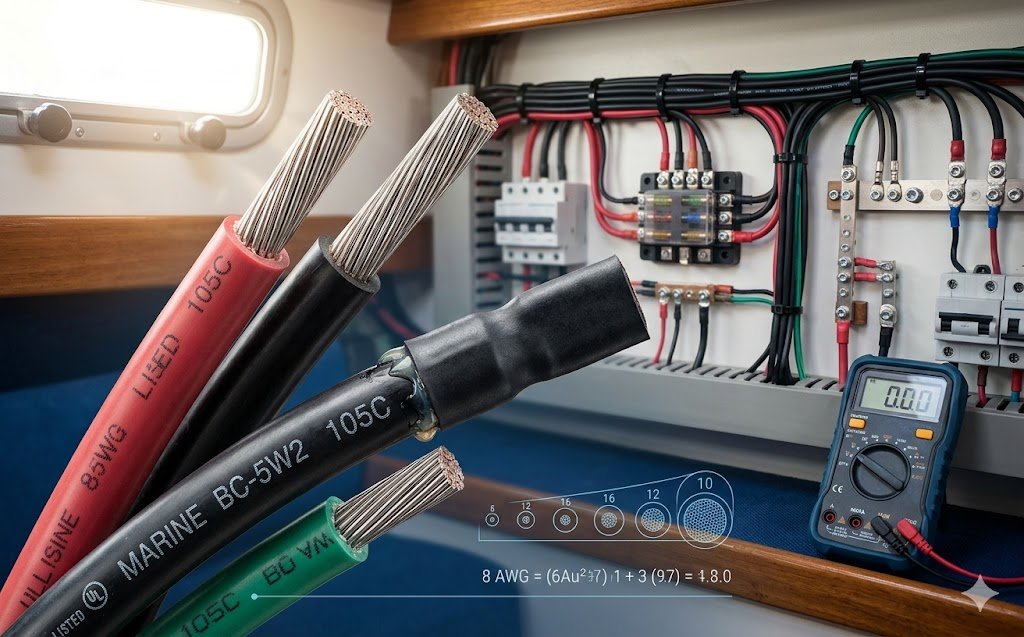
Tinned Copper Wire (UL 1426): Look for “BC-5W2” on the jacket. Unlike house wire, every strand is coated in tin to stop corrosion (green rot).
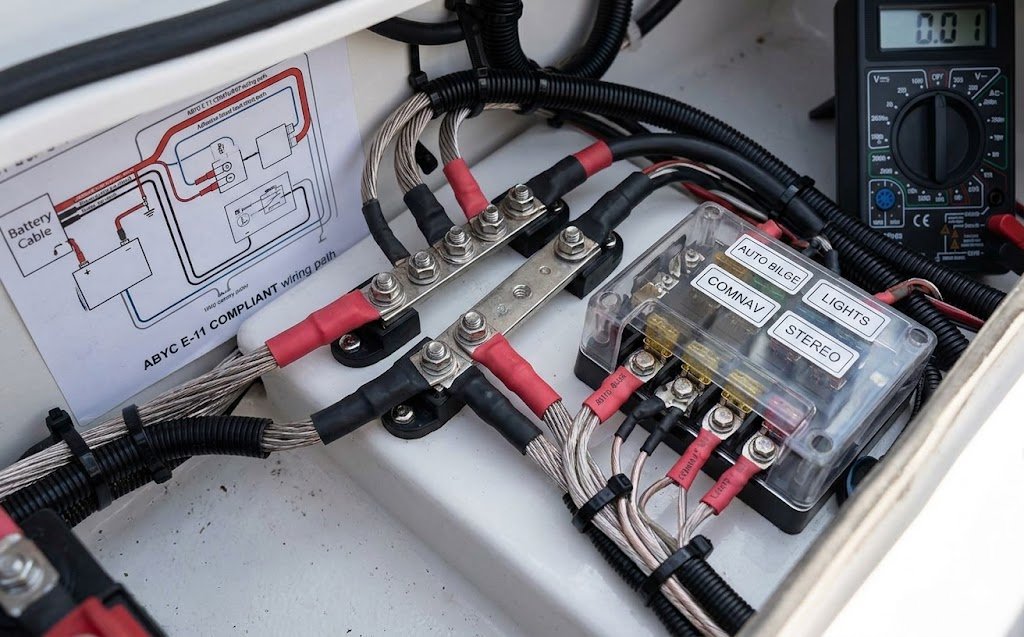
Adhesive-Lined Heat Shrink Terminals: Avoid the “hard plastic” hardware store connectors. Marine terminals have glue inside that melts when heated, sealing out salt air and moisture.
Marine Grade Fuse Blocks & Holders: Ensure your fuse holders are ignition-protected if they are being installed in an engine or battery box.
Nylon Cable Ties (UV Rated): Standard white zip-ties get brittle and snap in the sun. Use black, UV-rated ties for any wiring exposed to the elements.
Corrosion Inhibitor (T-9 or Lanocote): A tiny dab on your battery terminals and busbars will double the life of your connections.
Need Another Tool?
Back to our full suite of ABYC-compliant marine electrical calculators.
View All Marine Tools →
Leave a Reply