Quick Navigation
Table of Contents
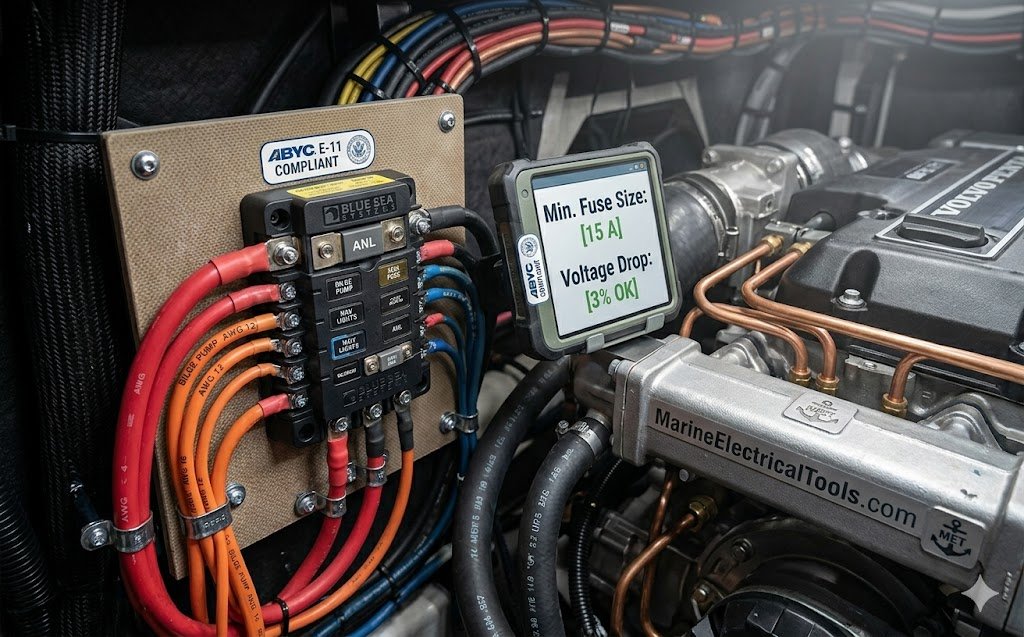
Using a professional Marine Fuse Size Calculator is the best way to make sure your boat’s electrical system stays “shipshape” and doesn’t turn into an accidental smoke machine. I designed this ABYC-aligned Marine Fuse Size Calculator to take the guesswork out of your weekend projects, helping you nail the perfect fuse rating for any DC circuit on your rig.
By sticking to ABYC E-11 standards, we’re calculating safety based on your actual wire gauge and load—because “close enough” isn’t a great strategy when it comes to preventing electrical fires. Whether you’re swapping out a bilge pump or adding some fancy new GPS gear, stop playing the guessing game and start sizing your fuses with a little professional-grade precision.
Input Your Data Below
Keeping boaters safe, one cup of joe at a time.
How This Marine Fuse Size Calculator Works: ABYC E-11 Standards Explained
Understanding how this calculator works is key to ensuring your boat’s electrical safety. I designed this tool to be built on the foundation of ABYC E-11 standards, specifically designed to prioritize the protection of your marine-grade wiring. Unlike generic tools, this Marine Fuse Size Calculator accounts for the critical relationship between wire ampacity, voltage drop, and overcurrent protection. By inputting your specific DC circuit data—including AWG wire gauge, load type, and environmental factors—the calculator applies precise mathematical formulas to prevent thermal overload and potential fire hazards.
Essential ABYC Rules for Marine Overcurrent Protection
The Golden Rule: Protect the Wire, Not the Device
A common mistake in boat maintenance is sizing a fuse to the appliance. I have personally made this mistake in my newbie stages. However, marine fuses are specifically sized to protect your marine-grade wiring from overheating and potential fire. By capping the current before the wire reaches its thermal limit, you ensure the integrity of your entire DC electrical system.
Compliance with ABYC E-11 Standards
This Marine Fuse Size Calculator is built using official ABYC E-11 overcurrent protection rules. We utilize industry-standard ampacity tables for 105°C tinned copper marine wire, automatically applying the necessary safety factors for engine room temperatures and wire bundling (derating).
Sizing for Continuous vs. Intermittent Loads
The duration of your electrical draw significantly impacts heat buildup:
Continuous Loads: For devices running for more than 3 minutes (like refrigeration or navigation lights), ABYC requires fuses to be sized at 125% of the continuous current to prevent nuisance trips and heat fatigue.
Intermittent Loads: Short-duration draws (like a windlass or horn) utilize different sizing rules to allow for high start-up surges without compromising the safety of the circuit.
Step‑by‑Step Instructions: How to Calculate Marine Fuse Size
Follow these four simple steps to get the most out of the Marine Fuse Size Calculator and ensure your boat’s DC circuits are protected, according to the latest ABYC E-11 standards. No need to blow up your boat my peeps!!
1. Select Your Wire Gauge (AWG)
Identify the American Wire Gauge (AWG) size currently installed in your circuit. This is the most critical step because the fuse’s primary job is to protect this specific conductor from overheating.
Not sure if your current wire can handle the load over that distance? Check our Marine Wire Gauge Calculator first to ensure you aren’t starting with an undersized conductor!
Pro Tip: Look for the printing on the wire jacket; most marine-grade tinned copper wires will have the AWG size clearly marked.
2. Enter Your Maximum Load (Amps)
Input the maximum current draw (in Amps) that your device or equipment pulls during normal operation. You can usually find this on the manufacturer’s data plate or in the owner’s manual.
3. Identify the Load Category
Choose whether your device is a Continuous or Intermittent load:
Continuous: Runs for 3 minutes or more (e.g., pumps, lights, electronics).
Intermittent: Runs for less than 3 minutes (e.g., windlass, horn, engine starters).
4. Adjust for Environment & Bundling
Specify if the wire is located inside a hot engine room or bundled with other wires. Our calculator automatically applies derating factors to account for these high-heat environments, ensuring your overcurrent protection doesn’t fail prematurely.
5. Review and Install
Once you hit calculate, the tool will provide the minimum ABYC-compliant fuse rating. Always ensure your fuse holder is also rated for the current and installed as close to the power source as possible.
Marine Fuse Calculation: A Real-World Example
To see how the ABYC E-11 rules are applied in practice, let’s look at a common scenario for a small boat’s electronics circuit.
The Scenario:
- Wire Size: 14 AWG (Tinned Copper Marine Grade)
- Device Load: 10 Amps (Continuous)
- Circuit Type: 12V DC
- Installation Area: Outside the engine room (Open Air)
The Calculation Process:
- Check Base Ampacity: A 14 AWG wire is generally rated for 35 Amps in open air.
- Apply Continuous Load Rule: Since the load is continuous, we calculate 125% of 10A, which equals 12.5 Amps.
- Find the Nearest Standard Fuse: To protect the wire while preventing nuisance trips, we move up to the next standard fuse size.
The Result:
The Marine Fuse Size Calculator recommends a 15A Fuse for this specific scenario. This rating is high enough to handle the 12.5A continuous requirement but low enough to blow long before the 14 AWG wire reaches its 35A thermal limit.
ABYC E-11 Technical Reference Summary
For those performing a professional installation, here are the core technical parameters utilized by this calculator:
Standard Compliance: All calculations are derived from ABYC E-11 (AC/DC Electrical Systems on Boats) standards.
- Conductor Type: Assumes the use of SAE J1127 or UL 1426 (105°C rated) tinned copper marine-grade wire.
- Overcurrent Protection (OCP) Timing: Fuses must be installed within 7 inches of the power source (or up to 72 inches if the wire is contained in a sheath/enclosure) to meet safety compliance.
- Voltage Drop Limits: * 3% Max Drop: For critical “Mission-Dependent” circuits (Navigation lights, bilge pumps, electronics).
- 10% Max Drop: For non-critical general lighting and accessory circuits.
- Safety Margin: A 1.25 multiplier is applied to all continuous loads to account for heat-induced resistance.
Frequently Asked Questions (FAQ)
What is the purpose of a marine fuse?
A marine fuse is designed specifically to protect the electrical conductor (wire) from overheating and causing a fire. It is not intended to protect the end-device, but rather to act as a “safety valve” for the wire’s thermal limit.
Is it safe to oversize a fuse on a boat?
No. Oversizing a fuse is a dangerous practice that can allow the wire to carry more current than it is rated for. This leads to insulation melting and electrical fires. Always stick to the ABYC-compliant fuse rating provided by the calculator.
Can I use this for AC shore power circuits?
No. This tool is strictly for DC (Direct Current) marine circuits (12V, 24V, or 48V). AC systems follow different safety protocols and require specialized circuit protection.
Why does this tool assume tinned copper wire?
ABYC E-11 standards recommend tinned copper marine-grade wire because of its superior resistance to corrosion in saltwater environments. Untinned “automotive” wire can corrode internally, increasing resistance and heat.
Marine Electrical Safety Checklist
Before finalizing your installation, ensure you follow these critical safety protocols:
- Use Ignition-Protected Components: If installing in an engine room or fuel tank space, ensure fuses and holders are SAE J1171 ignition protected.
- Proximity to Power: Install your overcurrent protection as close to the battery or power source as possible (ideally within 7 inches).
- Environmental Check: Periodically inspect all marine wiring for signs of heat fatigue, green corrosion, or insulation chafe.
- No Substitutions: Never replace a marine-grade fuse with an automotive version, as they may not have the same Interrupt Capacity (AIC) required for large battery banks.
Think of your fuses as the ‘silent heroes’ of your boat. While your wiring does the heavy lifting, a properly sized fuse is there to step in and save your equipment (and your boat!) if things ever go sideways. Fuses and wires are a package deal—you can’t really size one without the other. To make sure your project is solid from start to finish, here are a few other tools that help you get those fuse calculations just right:
- Marine Wire Gauge Calculator (ABYC Aligned) – This is your best friend for fuse sizing. Since a fuse’s main job is to protect the wire, you’ll want to use this to make sure your wire can handle the load before you pick the fuse to guard it.
- Marine Inverter Size Calculator (ABYC Compliant) – Inverters pull a lot of power, and this tool specifically helps you figure out the high-amp fuses you’ll need to keep those big DC cables safe.
- Battery Charger Size Calculator – Charging systems need protection on both ends. Use this to help determine the right fuse sizes for your charger’s output to the battery bank.
- Marine Battery Bank Size Calculator (ABYC Compliant) – Your total battery capacity helps determine the ‘short-circuit current’ your fuses might have to handle, so it’s always good to have your bank size dialed in first.
Getting these pieces to work together is what turns a ‘good’ electrical project into a professional, worry-free setup for your time on the water.
Need Another Tool?
Back to our full suite of ABYC-compliant marine electrical calculators.
View All Marine Tools →
Leave a Reply