Quick Navigation
Table of Contents
This Marine Solar Panel Size Calculator helps you determine the correct solar array size for your boat based on daily energy usage, battery capacity, charging efficiency, and available sunlight hours. It follows ABYC-aligned best practices to ensure your solar system is sized safely and reliably for real-world marine conditions.
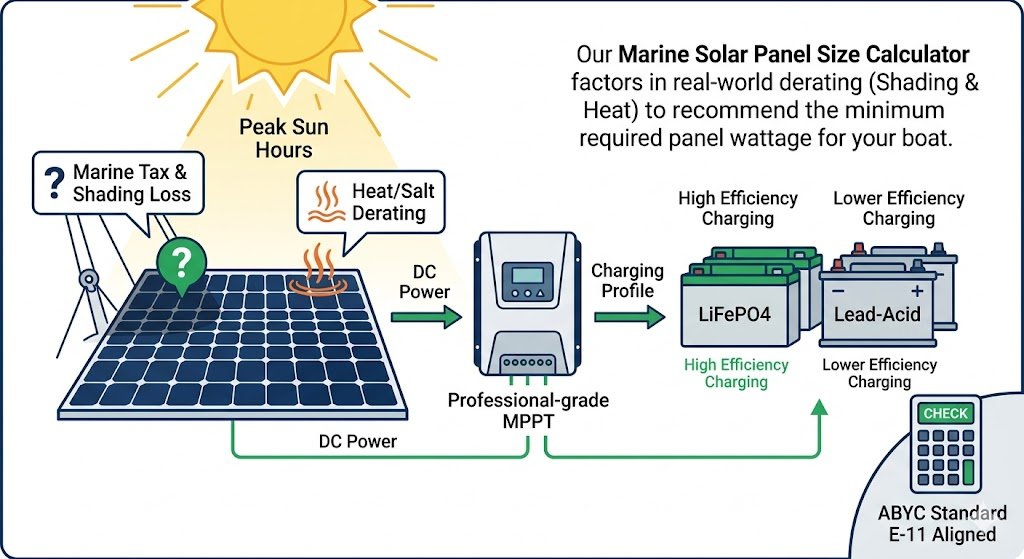
Let’s be honest: sizing solar for a boat isn’t like doing it for a house that actually stays still. On a boat, you’re dealing with the “Marine Tax”—which is basically the universe’s way of saying a single mast shadow or a well-placed bird dropping can slash your power output by half.
I’ve seen plenty of folks slap a single panel on the Bimini and hope for the best, only to end up sitting in a dark cabin with warm beer and a silent fridge by day two. I built this tool so you can stop “guestimating” and start actually harvesting that free Vitamin D from the sun without the mid-voyage power anxiety. Let’s get your bank topped off so you can keep the tunes spinning and the lights on without any “low voltage” drama, my boating buddies!
Marine Solar Array Sizing Calculator
DIY Tip: This calculator uses ABYC-aligned standards to ensure your boat stays powered even when the clouds roll in. We factor in the “Marine Tax” (shading) that land-based calculators ignore.
Why You Need a Marine Solar Panel Size Calculator (The ABYC Way)
Sizing a solar array for a boat is fundamentally different than sizing one for a house. On the water, you deal with moving shadows, salt spray, and the limited physical “real estate” of a bimini or arch. To build a system that won’t leave you in the dark, we follow a professional four-step process.
Step 1: Establish Your Daily Load (Ah)
The most common mistake is underestimating how much power you actually use. 30-60 Amp-hours (Ah) per day is a standard range for a typical marine fridge, but if you’re like me and prefer your drinks ice-cold in the Bahamas, you’ll want to aim for that higher number. Don’t let a thirsty compressor catch your battery bank off guard, my friends! Using our dedicated marine solar panel size calculator ensures you don’t overlook variables like rigging shadows that a standard calculator might miss.
- DIY Tip: Don’t guess. Look at your battery monitor (like a Victron BMV) over a 24-hour period while at anchor to find your true “House” consumption.
- Pro Tip: Always calculate for your “Worst Case” scenario, typically a hot summer day with the fridge cycling frequently.
Step 2: Understanding Peak Sun Hours (PSH)
A common “dummy” mistake is assuming that 12 hours of daylight equals 12 hours of charging. I’ve done this myself. In reality, solar panels only produce their rated output during Peak Sun Hours—the window when the sun is high enough in the sky to provide 1,000 W/m² of irradiance.
- Tropical Cruising: Usually averages 5 to 6 PSH.
- High Latitudes (Pacific Northwest/UK): Can drop to 2 or 3 PSH in the shoulder seasons.Our calculator uses these hours to determine how much “time” your panels have to replenish your batteries.
Step 3: The “Marine Tax” (Shading & Derating)
Engineers use a Derating Factor to account for real-world losses. On a boat, a single wire from the rigging casting a shadow across a panel can drop its output by 50% or more.
- Standard Loss: We factor in a 1.5x multiplier for most sailboats to account for mast shadows and heat.
- Efficiency Loss: No solar controller is 100% efficient. While an MPPT (Maximum Power Point Tracking) controller is excellent, you still lose roughly 5-10% of energy during the voltage conversion process.
Step 4: Sizing the Charge Controller
Once you know your total wattage, you must ensure your charge controller can handle the current. The formula is:
Amps = Total Watts / Battery Voltage
We always recommend adding a 20% safety margin to this figure. This prevents the controller from “clipping” (limiting power) on exceptionally clear, cold days when panels can actually exceed their rated output—a phenomenon known as the “Cloud Edge Effect.”
Safety & Compliance (ABYC E-11)
When installing your array, remember that the ABYC E-11 standard requires that every power source (including solar) be fused.
- Overcurrent Protection: A fuse or circuit breaker must be installed within 7 inches of the battery connection.
- Wire Sizing: Ensure the wire between your panels and the controller is sized for less than a 3% voltage drop to maximize every watt you’ve harvested.
Frequently Asked Questions: Marine Solar Design
Why should I use a dedicated Marine Solar Panel Size Calculator?
Standard residential solar calculators don’t account for the “Marine Tax.” On a boat, factors like salt spray buildup, high ambient heat on a deck, and the constant movement of shadows from the mast significantly reduce efficiency. Using a marine solar panel size calculator ensures your system is derated correctly for the harsh offshore environment.
Does battery chemistry affect my solar calculation?
Yes. While the solar panels harvest the energy, the battery type determines how efficiently that energy is stored. LiFePO4 (Lithium) batteries have a round-trip efficiency of nearly 99%, whereas Lead-Acid or AGM batteries lose about 15-20% of that energy as heat during the charging process. Our calculator assumes a standard efficiency buffer to keep you safe regardless of battery type.
How do I account for the “Cloud Edge Effect”?
The “Cloud Edge Effect” occurs when sunlight reflects off the sides of clouds, momentarily increasing the irradiance beyond standard test conditions. This can cause a surge in amperage. This is why our marine solar panel size calculator adds a 20% safety margin when recommending a charge controller size—preventing your equipment from blowing a fuse or over-heating during these spikes.
Pro Tip: Once you’ve used the Marine Solar Panel Size Calculator to design your array, head over to our Marine Wire Gauge Calculator to ensure your cables can handle the new current safely.
⚓ Pro Engineer Note: Limited Deck Space?
If the Recommended Panel Count exceeds your available “real estate” (common on sailboats), you have three professional options:
- Supplement with Alternator Charging: Use a high-output alternator with an external regulator to handle the “Bulk” charge phase.
- Add a Wind Generator: Wind often picks up when the sun goes down, providing a balanced energy profile.
- Upgrade to High-Efficiency Cells: Use Marine Solar Panels with SunPower Maxeon cells, which offer higher wattage in a smaller physical footprint.
Solar power is one of the best ways to keep your batteries topped off without having to run the engine. But a solar panel is only as effective as the controller and wiring that deliver that power to your bank. To make sure you’re getting every drop of energy from the sun, here are the tools that go hand-in-hand with your solar calculations:
- Marine Solar Charge Controller Size Calculator (ABYC-Aligned) – Once you know your panel wattage, use this to find the right controller. It includes the ABYC ‘cloud-edge’ safety factor so you don’t cook your equipment on a bright day.
- Marine Wire Gauge Calculator – Solar panels are often mounted far away from the batteries. Use this to size your wires correctly so you don’t lose all that hard-earned solar voltage to heat in the wires.
- Marine Battery Bank Size Calculator (ABYC Compliant) – Solar is great for ‘putting it back,’ but you need a big enough ‘bucket’ to hold it. This tool ensures your battery bank is sized to handle your daily loads when the sun goes down.
- Battery Charger Size Calculator – For those cloudy days or when you’re at the dock, you’ll still need a reliable way to charge. This helps you size your shore-power charging system to complement your solar array.
By matching your solar panels with the right controller and wiring, you’re building a truly independent and ‘rock-solid’ marine power system.
For Other Free Tools, Please Visit our Home Page
Back to HomeMarine Solar Glossary: Essential Terms
Click each term below to see how it impacts your solar array design and safety.
+ Peak Sun Hours (PSH)
PSH represents the total solar radiation received in a day expressed as the number of hours at an intensity of $1000W/m^2$. It is the core metric our Marine Solar Panel Size Calculator uses to estimate daily energy harvest.
+ MPPT (Maximum Power Point Tracking)
A high-efficiency DC-to-DC converter that optimizes the match between the solar array and the battery bank. Unlike PWM controllers, MPPT can increase your harvest by up to 30% in cloudy or partially shaded marine environments.
+ Irradiance
The power per unit area ($W/m^2$) received from the sun. Irradiance varies based on your latitude, time of day, and atmospheric conditions (like salt haze or humidity).
+ Voltage Drop
The loss of electrical potential as current flows through a wire. We use the Marine Solar Panel Size Calculator to ensure our solar array is large enough to compensate for these system-wide losses, keeping your batteries charging at the correct voltage.
+ Derating Factor (The Marine Tax)
A multiplier used to adjust the “Standard Test Condition” (STC) ratings of a panel to reflect real-world boat conditions, including high ambient temperatures, salt buildup, and mast shading.
+ VOC (Voltage Open Circuit)
The maximum voltage a solar panel produces when it is not connected to a circuit. This value is critical for ensuring you do not exceed the input voltage limits of your MPPT charge controller.
+ ISC (Short Circuit Current)
The maximum amperage a panel can produce. Following ABYC E-11, this value determines the required ampacity of your wires and the size of your overcurrent protection (fuses).
Leave a Reply