Quick Navigation
Table of Contents
Shore Power Load Calculator
Calculate your vessel’s total electrical demand to ensure you select the correct shore power service (30A, 50A, or 100A). Instructions: Enter the quantity of each appliance currently running. If an appliance isn’t listed, use the “Custom Load” row at the bottom.
The Ultimate Guide to Managing Your Shore Power Load
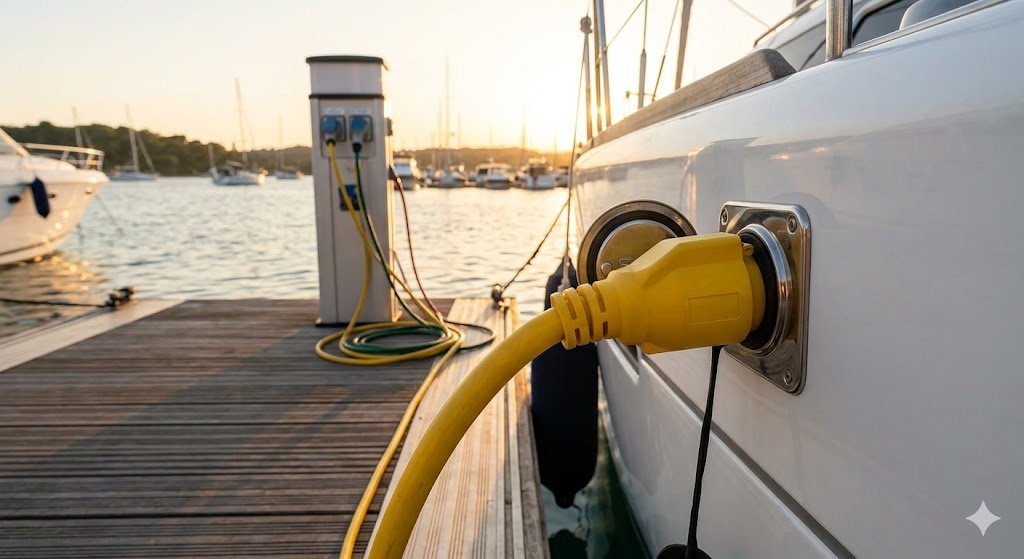
Understanding your Shore Power Load is critical for both safety and convenience while living aboard or visiting a marina. Whether you are plugged into a standard 30-amp pedestal or a heavy-duty 100-amp service, managing your AC (Alternating Current) demand ensures you don't trip breakers or damage sensitive onboard electronics.
Why Use a Shore Power Load Calculator?
Most boaters underestimate how quickly modern conveniences add up. An air conditioner, a water heater, and a simple coffee maker running simultaneously can easily exceed 4,000 watts. On a 120V/30A system, your maximum continuous capacity is roughly 2,880 watts (applying the 80% rule for continuous loads). Using a Shore Power Load Calculator allows you to visualize your "energy budget" before you start flipping switches.
Understanding the 125% Safety Factor
You may notice our calculator applies a 125% buffer to your total amperage. This isn't an arbitrary number; it aligns with standards set by the American Boat and Yacht Council (ABYC). Electrical circuits are rated for maximum "peak" loads, but for "continuous" loads (anything running for three hours or more), you should only utilize 80% of the circuit's capacity. By calculating for 125% of your requirement, we ensure your shore power cord and inlet remain cool and safe.
Common Marine Appliance Wattage Reference
If you don't have your appliance manuals handy, use these industry averages to estimate your shore power load:
| Appliance | Estimated Watts | Amps (at 120V) |
| Roof AC (15k BTU) | 1,500 - 1,800W | 12.5 - 15A |
| Electric Water Heater | 1,200 - 1,500W | 10 - 12.5A |
| Battery Charger | 500 - 1,200W | 4 - 10A |
| Microwave Oven | 1,000 - 1,500W | 8 - 12.5A |
| Hair Dryer | 1,200 - 1,800W | 10 - 15A |
Managing "Inrush Current"
One thing a static Shore Power Load Calculator can't always predict is "Inrush Current." When a compressor for a refrigerator or air conditioner first kicks on, it can pull 3 to 5 times its running wattage for a fraction of a second. If your base load is already high, these spikes are what typically trip your pedestal breaker. To manage this, many boaters install "Soft Start" devices or utilize advanced inverter/chargers from brands like Victron Energy that feature "Power Assist" technology to supplement shore power with battery power during peaks.
Tips for Reducing Your AC Demand
- Stagger Your Loads: Avoid running the microwave while the water heater is recovering.
- Switch to LED: While small, lighting adds up over dozens of fixtures.
- Monitor Your Pedestal: Check your shore power plug for signs of heat or discoloration. High resistance caused by corrosion increases heat and decreases efficiency.
- Use High-Quality Cables: Ensure your shore power cords are marine-rated and free of nicks or tight bends.
Plugging into shore power is a relief after a long trip, but it’s also when your boat’s electrical system is most connected to the outside world. To make sure your dockside power is safe and your boat is protected from stray currents, here are the tools that work alongside your shore power calculations:
- Shore Power Load Calculator – This is your primary tool for auditing your AC demands. It helps you ensure you aren't overloading your shore power inlet or your boat's main breaker when you fire up the A/C and the water heater at the same time.
- Anode Calculator – Shore power connects your boat's ground to every other boat on the dock. Use this tool's 'Shore Power Factor' to see how being plugged in increases the demand on your sacrificial anodes.
- Marine Inverter Size Calculator (ABYC Compliant) – Many shore power systems include an Inverter/Charger. This tool helps you size that system so it can handle your AC loads and charge your batteries efficiently while you're at the dock.
- Battery Charger Size Calculator – Your shore power connection is the main way you'll recharge your bank. This tool ensures your charger is sized correctly to get your batteries back to 100% before your next departure.
By looking at your shore power and corrosion protection as one integrated system, you're building a setup that's safe for your crew and your boat's underwater metals.
Conclusion
By calculating your Shore Power Load accurately, you protect your vessel's electrical system and enjoy a more reliable experience at the dock. Remember, when in doubt, "load shedding" (turning off non-essential items) is the safest way to ensure your primary systems, like bilge pumps and chargers, stay active.