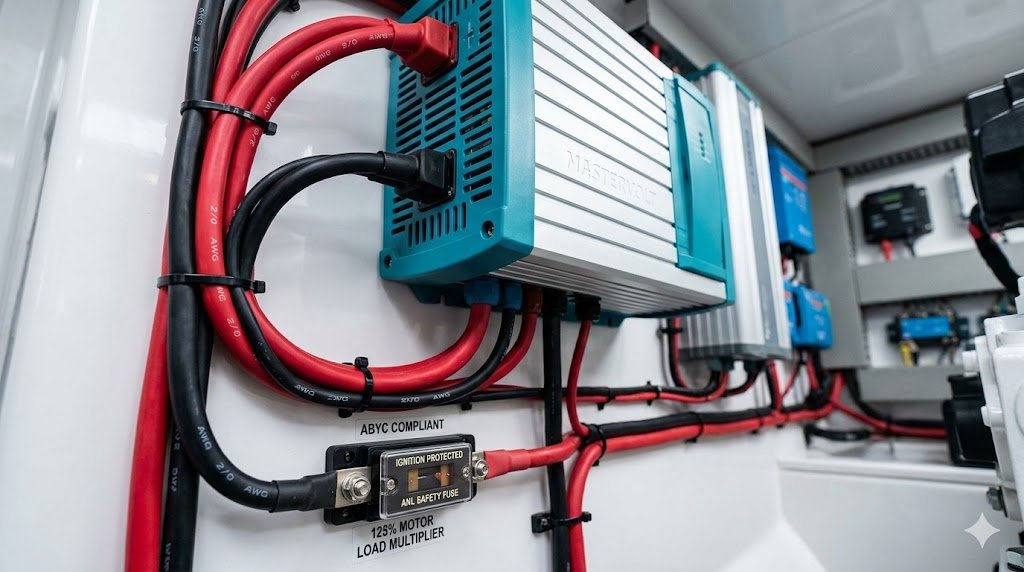
Selecting the right marine inverter is critical for ensuring your onboard AC loads run reliably without straining your DC system. Our Marine Inverter Size Calculator(ABYC Compliant) is designed specifically for boat owners and marine technicians to determine the ideal inverter capacity based on real-world power demands.
Whether you’re just trying to keep a laptop charged so you can work from the cove or you’re firing up a power-hungry microwave for a quick hot meal, use this calculator to size your inverter, fuse, and wiring for maximum safety. Let’s keep the sparks in the engine, not in the wiring, my peeps!
Quick Navigation
Table of Contents
Marine Inverter Size Calculator
Professional-grade sizing aligned with ABYC E-11 safety standards.
Common Marine AC Appliance Wattages
Use these estimated values if you are unsure of your appliance’s specific requirements. Always check the manufacturer’s label for exact “Nameplate” data.
| Appliance | Running Watts | Startup Surge |
|---|---|---|
| LED Lights (per bulb) | 8-10W | None |
| Starlink (High Performance) | 110-150W | None |
| Laptop (MacBook/PC) | 60-100W | None |
| Marine Fridge (Compressor) | 60-100W | 500-800W |
| Microwave (Small) | 800-1200W | None |
| Coffee Maker (Single Serve) | 1200-1500W | None |
| Air Conditioner (10k BTU) | 1200W | 3000W+ |
Understanding ABYC E-11 Inverter Requirements
To ensure a safe marine electrical installation, the American Boat and Yacht Council (ABYC) provides specific guidelines in the E-11 standard. A “rock solid” installation isn’t just about the inverter size; it’s about the system’s ability to handle the Total Connected Load.
The marine inverter size calculator applies a 125% safety multiplier to your largest inductive load (like a motor or compressor). This is critical because motors require a massive “inrush” of current to start. If your inverter is sized exactly to the running watts, it will likely trip a low-voltage alarm or shut down entirely the moment your fridge kicks on.
Pre-Installation Safety Checklist
Before finalizing your inverter selection, ensure your vessel’s electrical infrastructure can support the new AC power source:
- Overcurrent Protection: Does your DC input line have an ignition-protected fuse rated for the inverter’s maximum DC draw?
- Cable Gauge: Are your battery cables sized to prevent a voltage drop of more than 3%? (Use our Marine Wire Gauge Calculator to verify).
- Ventilation: Does the mounting location provide at least 3 inches of clearance for cooling fans to prevent thermal throttling?
- Grounding: Is the inverter chassis connected to the boat’s DC grounding system per ABYC E-11 standards to prevent galvanic corrosion?
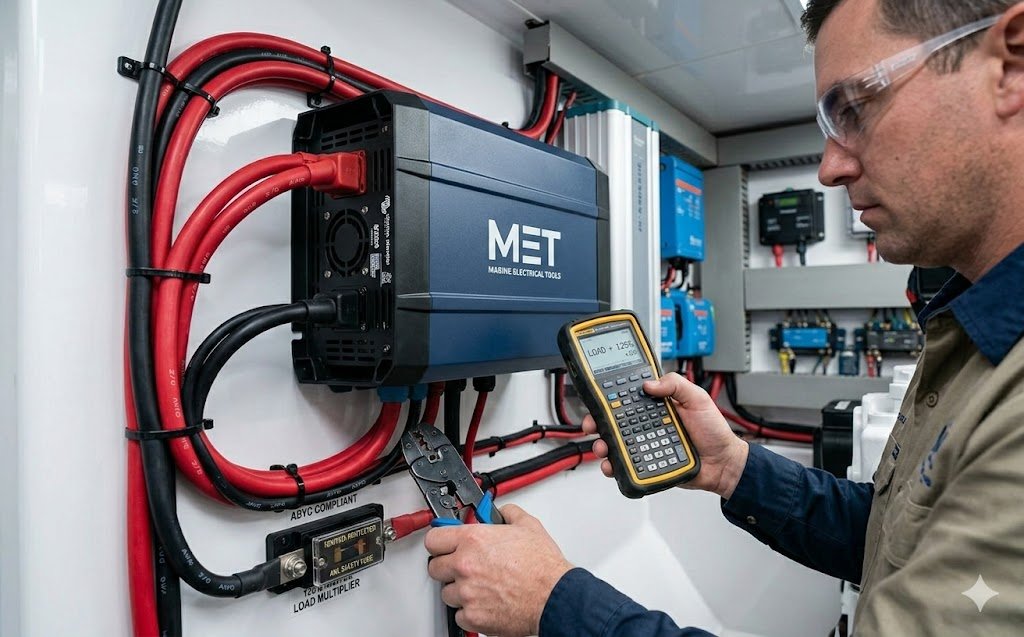
Pro Tip: When sizing your inverter, remember that the DC side (your batteries) must be able to keep up. For every 100 Watts of AC power you use, your 12V battery bank must provide approximately 10 Amps of DC current (accounting for efficiency losses).
Marine Inverter Size Calculator: Frequently Asked Questions
Can I run my air conditioner on an inverter?
Yes, but it requires a large inverter and a massive battery bank. A standard 10,000 BTU marine A/C unit draws about 120 Amps of DC current. Most technicians recommend at least a 3000W Pure Sine Wave inverter for these loads.
What is the difference between Modified Sine Wave and Pure Sine Wave?
For a “rock solid” marine build, always choose Pure Sine Wave. Modified sine waves can damage sensitive electronics like microwave timers, digital coffee makers, and laptop power bricks.
Why does the calculator show higher Amps than my appliance label?
The marine inverter size calculator accounts for Inverter Efficiency (85%). Because the inverter consumes power just to stay turned on and loses energy as heat during the conversion from DC to AC, your battery must work harder than the appliance’s label suggests.
Marine Inverter & Electrical Glossary
- Pure Sine Wave (PSW): High-quality AC power that matches a shore power pedestal. Required for sensitive electronics and modern appliances to prevent damage or “buzzing.”
- Modified Sine Wave (MSW): A simpler, “stair-step” power wave. While cheaper, it can cause motors to run hot and may stay incompatible with some microwave timers or laptop chargers.
- Continuous Rating: The maximum wattage an inverter can provide indefinitely. Our Marine Inverter Size Calculator focuses on this for your total “Always On” load.
- Surge (Peak) Power: The short-term burst capacity (usually 1-5 seconds) required to start inductive motor loads like refrigerators or air conditioners.
- Idle Draw (Quiescent Current): The amount of power an inverter consumes from your Battery Bank just by being turned on, even with no AC loads active.
- Transfer Switch: A device that automatically switches your boat’s outlets between inverter power and shore power when you plug into the dock.
- Ignition Protected: A safety rating required by ABYC for any electrical component installed in an area where explosive fumes (like gasoline) may be present.
- Inverter Efficiency: The percentage of DC power successfully converted to AC. Most modern marine inverters operate at roughly 85-90% efficiency, with the rest lost as heat.
Selecting the right inverter is what lets you bring the comforts of home—like that morning coffee or a quick microwave meal—out to the cove. But an inverter is only as good as the system supporting it. To make sure your AC power is reliable and safe, here are the tools that help you size everything around your inverter:
- Marine Wire Gauge Calculator – This is a must-use for inverters. Because they pull massive amounts of DC current, your battery cables need to be heavy-duty to prevent voltage drop and keep your inverter from tripping off under load.
- Marine Battery Bank Size Calculator (ABYC Compliant) – Your inverter is a ‘power hungry’ guest! Use this to make sure your battery bank has enough capacity to handle your inverter’s demands without draining your batteries too deep.
- Battery Charger Size Calculator – If you’re using a lot of inverter power, you’ll need a way to put that energy back. This tool helps you size a charger that can keep up with your daily power consumption.
- Shore Power Load Calculator – Many modern inverters are actually ‘Inverter/Chargers.’ This tool helps you understand how your shore power connection handles the load when you’re charging and running appliances at the same time.
By sizing your inverter, wiring, and batteries as one team, you’re ensuring a setup that’s safe, efficient, and ready for any adventure.