Quick Navigation
Table of Contents
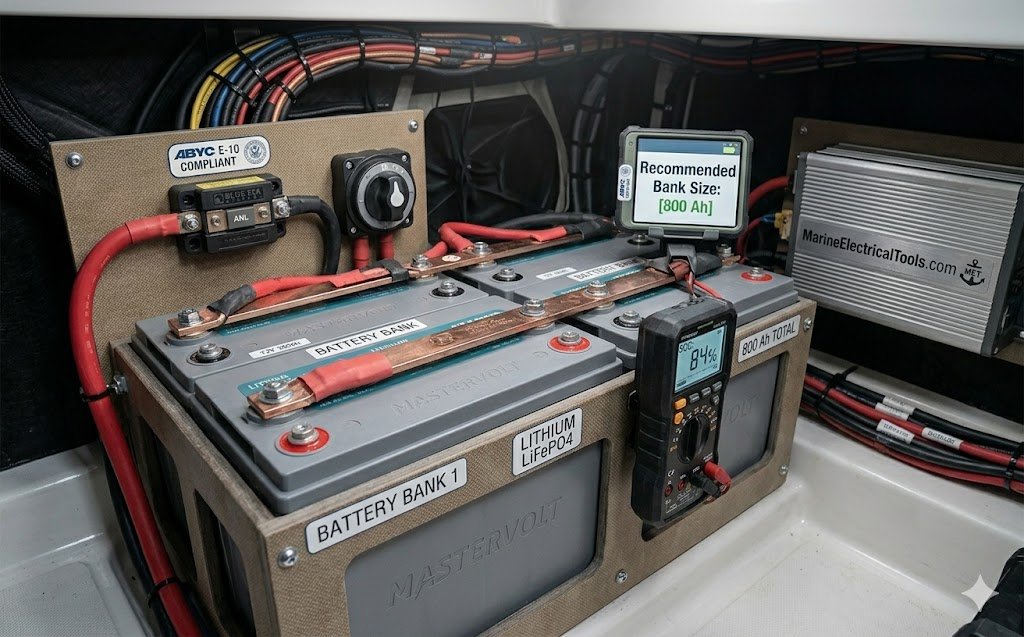
This Marine Battery Bank Size Calculator helps you determine the correct battery capacity for your boat based on daily energy usage, system voltage, depth-of-discharge limits, and charging considerations. It follows ABYC-aligned best practices to ensure your battery bank is sized safely and reliably for real-world marine conditions.
Input Your Data Below
1. Estimate Your Daily DC Loads
Add your appliances below to calculate your total Amp-Hours (Ah) per day.
| Appliance | Amps | Hours/Day | Total Ah |
|---|
2. Battery System Settings
Recommended Battery Bank Size
Based on ABYC safe discharge limits.
Invest in the next tool on our roadmap.
Let’s be honest: there is a specific kind of “silent panic” that sets in around 3:00 AM when you’re at anchor and you start wondering if the fridge is going to kill the house bank before sunrise. We’ve all been there—lying in the v-berth, doing mental math instead of sleeping. I built this tool to end that guesswork. Whether you’re running a modest weekend setup or a high-tech Lithium (LiFePO4) bank for full-time cruising, getting your capacity right is the difference between a peaceful night’s sleep and a stressful morning with a set of jumper cables.
How This Marine Battery Bank Size Calculator Works
Calculates Daily Energy Consumption
This tool doesn’t just guess; it accurately totals your cumulative daily amp-hour usage across every individual DC load on your vessel. From the steady hum of your marine fridge to the intermittent draw of bilge pumps and cabin lights, we look at the “big picture” of your energy diet.
Think of your battery bank like a fuel tank. If you don’t know how many gallons you’re burning per hour, you have no idea when you’ll run dry. By listing every LED, chartplotter, and VHF radio, you get a realistic view of your “burn rate” while offshore or at anchor.
Applies Depth‑of‑Discharge Limits
To maximize battery life and keep you from being stranded, I’ve built this calculator to apply recommended Depth-of-Discharge (DoD) limits. If you drain a battery to 0%, you aren’t just out of power—you’re actively killing the battery’s chemistry.
- Lead‑acid / AGM: We cap these at 50% usable capacity.
- Lithium (LiFePO4): These “super-batteries” allow for 80–90% usable capacity.
Considers System Voltage
The “pressure” in your wires matters. Higher system voltages (24V or 48V) allow you to move the same amount of power with less current (Amps). This means less heat, smaller wires, and often a more efficient battery bank. Our calculator adjusts the math automatically so your Amp-Hour requirements stay accurate regardless of your boat’s “blood pressure.”
The Captain’s Note on Temperature and Loads
Physics can be a bit of a bully on the water. If you’re a “shoulder season” sailor, remember that battery capacity drops by roughly 20% in near-freezing temperatures. Batteries hate the cold just as much as we do.
Furthermore, if you’re sticking with Lead-Acid, heavy loads (like an electric windlass or microwave) cause the Peukert Effect. It’s like trying to drink a thick milkshake through a tiny straw; the harder you pull, the less you actually get out of the battery. If you plan on running high-load inverters on Lead-Acid, I always suggest sizing up by an extra 20% just to keep the “milkshake” flowing.
Step‑by‑Step Instructions
Step 1: Enter Daily Amp‑Hour Usage
Be honest with your numbers…I know it’s hard lol! Add up the total amp‑hours consumed by your boat in a typical 24‑hour period. If you aren’t sure, use our “Quick Add” presets for common gear like GPS units and cabin lights.
Step 2: Select Battery Chemistry
Choose between traditional Lead‑acid/AGM or modern Lithium. This choice changes everything from how deep you can discharge to how much the bank weighs.
Step 3: Choose System Voltage
Most recreational boats are 12V, but if you’re building a power-hungry trawler, you might be looking at 24V or 48V.
Step 4: Review Recommended Battery Bank Size
The Marine Battery Bank Size Calculator will provide the minimum safe capacity you need to stay powered without damaging your gear.
Example Calculation
Example Scenario
Imagine a weekend cruiser with a daily usage of 120Ah, using AGM batteries on a 12V system.
Result
Because AGM batteries should only be discharged to 50%, the calculator recommends a 240Ah battery bank. This ensures you have enough “fuel” to run your lights and fridge without dipping into the “danger zone” that shortens battery life.
ABYC Standards & Best Practices
Depth‑of‑Discharge Guidelines
ABYC E-11 standards aren’t just suggestions; they are the blueprint for not having a “Viking Funeral” in the middle of the marina. We stick to conservative DoD limits because on the water, a dead battery is a safety hazard, not just an inconvenience.
Charging Considerations
Sizing the bank is only half the battle. You need to ensure your alternators, solar arrays, and shore power chargers are sized to “refill the tank” at a safe rate.
Cable Sizing & Protection
Large battery banks hold a massive amount of potential energy. Think of them like a coiled spring. If that energy is released all at once through a short circuit, things melt. Always ensure you have proper overcurrent protection (fuses or breakers) within 7 inches of the battery terminal. For more on this, check out our Marine Inverter Size Calculator.
Frequently Asked Questions (FAQ)
What is amp‑hour (Ah) capacity?
It’s simply a measure of energy storage. A 100Ah battery can theoretically deliver 1 Amp for 100 hours, or 10 Amps for 10 hours.
Does this work for lithium batteries?
Yes! This tool fully supports LiFePO4 chemistry and automatically adjusts the recommended size based on a safer, deeper 80% Depth of Discharge.
Can I mix battery types?
No. Mixing different chemistries (like an AGM starter and a Lithium house bank) without a specialized DC-to-DC charger is a recipe for disaster and is definitely not ABYC-compliant.
Does this include inverter loads?
Yes—but you have to do a little conversion first. Take your AC appliance watts, divide by your battery voltage, and add those “DC Amps” to your daily usage list.
Safety Notes
- Always use marine‑grade batteries (no “car” batteries, please!).
- Follow ABYC E‑11 wiring guidelines.
- Ventilation is key: Lead-acid and AGM batteries can off-gas during heavy charging. Give them room to breathe.
Your battery bank is the ‘heart’ of your boat’s electrical system. Everything else—your lights, your fridge, your navigation—depends on it having enough life to get you through your time on the water. But the battery doesn’t work alone; it needs the right charging and protection to stay healthy for years. To help you build a rock-solid energy system, here are some tools that go hand-in-hand with your battery bank calculations:
- Battery Charger Size Calculator – Once you know your bank size, use this to find the perfect charger. A charger that’s too small will take forever, and one that’s too big can be hard on your batteries.
- Marine Inverter Size Calculator (ABYC Compliant) – If you’re planning to run AC appliances from your batteries, this tool helps you make sure your inverter and your battery bank are a perfect match.
- Marine Wire Gauge Calculator – Big battery banks need big cables! Use this to make sure your main battery leads are sized correctly to prevent voltage drop and keep things running cool.
- Shore Power Load Calculator – This helps you understand how much of your battery charging will be handled by shore power versus other sources when you’re back at the dock.
Getting the balance right between your battery capacity and your charging system is the secret sauce to a ‘worry-free’ boat.
Need Another Tool?
Explore our full suite of ABYC-compliant calculators for marine electrical systems.
View All Marine Electrical Tools →
Leave a Reply