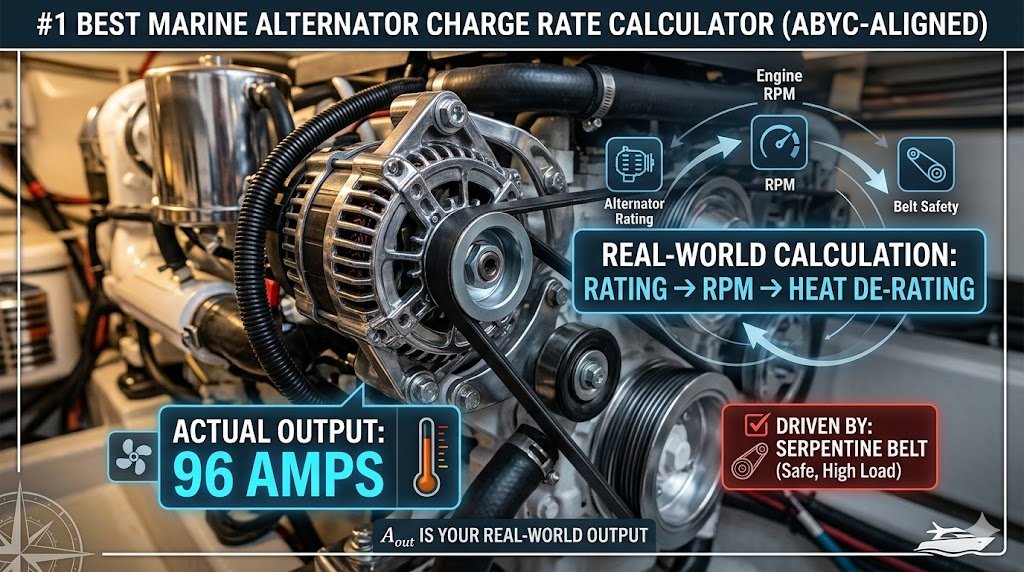
This Marine Alternator Charge Rate Calculator helps you estimate alternator charging output based on alternator rating, engine RPM, pulley ratios, and regulator type. It follows ABYC‑aligned best practices to ensure your charging system is sized safely and performs reliably in real‑world marine conditions.
Quick Navigation
Table of Contents
Alternator Charge Rate Advisor
Calculating your ABYC-aligned charge rate…
Why Your Alternator Rarely Hits its Rated Output
I’ll be honest with you: the “100 Amp” label on your alternator is a bit of a marketing dream. When I first started digging into marine charging systems, I was frustrated that my battery monitor never seemed to show the number I paid for.
In the real world, marine alternators are fighting two major enemies: Heat De-rating and RPM Curves. As your engine room heats up—which it does quickly in a cramped lazarette—the internal resistance of the alternator climbs. I usually tell people to expect a 20% drop in efficiency almost immediately once the engine reaches operating temperature. Our calculator factors in this “Real World” reality so you aren’t left wondering where your power went.
How an Alternator Charge Rate Calculator Handles Pulley Ratios
One of the most common complaints I hear from boaters is, “I’m running the engine at the dock, but I’m barely getting any charge!” This almost always comes down to the pulley ratio. Think of it like the gears on a bike; if the alternator isn’t spinning fast enough, it simply can’t “excite” enough to produce high current.
- 2:1 Ratio: This is what you’ll find on most standard diesel setups. It’s “okay,” but often leaves you underpowered at low RPMs.
- 3:1 Ratio: If you’re like me and you spend a lot of time at anchor or maneuvering at low speeds, this is the gold standard. It spins the alternator fast enough to actually pump amps into the house bank even when the engine is just ticking over at 800 RPM.
Belt Safety: The Hidden Danger of High-Output Alternators
I like to think of the drive belt as the “mechanical fuse” of your entire engine. If you try to pull too much power, something has to give.
- Single V-Belts: I generally don’t recommend pushing these past 80 Amps. I’ve seen far too many “black dust” scenarios where a single thin belt literally grinds itself into oblivion trying to turn a high-load alternator.
- Serpentine Belts: If you’re stepping up to the 130A+ range, you really need to move to a flat, multi-groove serpentine kit. It’s an investment, but it’s cheaper than a snapped belt and an overheated engine in the middle of a crossing.
External vs. Internal Regulation: Maximizing Amp Hours
Most alternators come with a “dumb” internal regulator. It’s designed to top off a starting battery and then quit. But for those of us with large house banks, that internal regulator is a massive bottleneck. It sees the voltage rise and “rolls off” the amperage way too early, leaving your batteries half-full.
I always suggest moving to a Smart External Regulator (like the Balmar MC-618). These devices allow the alternator to stay in “Bulk” mode much longer. Plus, they include temperature sensors. If the calculator predicts a high load and things start getting too hot, the smart regulator will safely dial back the output before you melt your expensive equipment.
Lithium (LiFePO4) Challenges: The Alternator Killer
Lithium is a game-changer, but I’ve seen it kill perfectly good alternators in under an hour. Unlike Lead Acid batteries, which naturally “resist” the charge as they get full, Lithium is thirsty. It will take every single Amp your alternator can produce until the alternator literally desolders its own internal parts from the heat.
If you’re moving to Lithium, you must use a regulator with a specific Lithium profile or install an Alternator-to-Battery (A2B) charger. It acts as a buffer to make sure your alternator doesn’t commit suicide trying to keep up with the demand.
Marine Alternator FAQ
Does engine speed affect alternator life? In my experience, yes. While higher RPMs help the internal fan cool things down, running at “wide-open throttle” with a massive electrical load creates a heat-soak that is hard to recover from. I always aim to hit peak output at your “cruising RPM” rather than redline.
Why is my battery monitor showing less than the calculator? The calculator tells you what the alternator is creating, but that doesn’t mean it’s all making it to the battery. If your wires are too thin, you’re losing power to heat along the way. I’d recommend checking our Marine Wire Size Calculator to make sure your “pipes” are big enough for the flow.
What is “Belt Dust” and should I worry? If you see black soot covering the front of your engine, you should definitely worry. That’s your belt being sacrificed. It’s a clear sign of slippage, usually because the alternator is demanding more torque than a single belt can provide.
My Personal 5-Step Checklist for Low Output:
- Check Tension: Use the “thumb test” on your belt. A loose belt is a wasted amp.
- Scrub Your Posts: I’ve fixed “broken” systems just by cleaning corrosion off the B+ post.
- The Ground Matters: Don’t forget the return path! A loose engine block ground is a common culprit.
- Watch the Alignment: If your pulleys aren’t perfectly straight, you’re wearing out belts and losing efficiency.
- Field Test: Ensure your regulator is actually sending the “Field” voltage required to wake the alternator up.
Your alternator is the “unsung hero” of your boat’s electrical system, working hard every time the engine is running to keep your batteries healthy. But treating a high-output marine alternator like a standard car alternator is a quick way to burn out your belts or, worse, your expensive battery bank.
To help you dial in your engine-driven charging system, here are the tools that work alongside your alternator calculations:
- Marine Battery Bank Size Calculator (ABYC Compliant) – Your alternator needs a “bucket” big enough to catch all that power. Use this to make sure your battery bank capacity matches your alternator’s output, especially if you’ve made the jump to high-performance Lithium.
- Battery Charger Size Calculator – While the alternator handles charging on the move, you still need a plan for when you’re at the dock. This helps you size a shore-power charger that complements your alternator’s performance.
By balancing your alternator’s output with the right wiring and battery capacity, you’re building a charging system that’s efficient, reliable, and ready for long hauls.
Explore more ABYC-Aligned Marine Electrical Tools