Quick Navigation
Table of Contents
Professional Anode Calculator
ABYC-Compliant Sizing Tool
How to Use the Anode Calculator for Boat Protection
Maintaining your vessel’s underwater metals is a critical part of maritime maintenance, but I’ve noticed it’s often the most misunderstood. This Anode Calculator is designed to provide boat owners with an ABYC-compliant estimate of the sacrificial anode mass required to prevent galvanic corrosion. Whether you are protecting a stainless steel shaft, a bronze propeller, or an aluminum hull, getting the weight right is the difference between a successful season and a costly haul-out. I always tell my clients: you’re either paying for the right anodes now, or a new set of props later.
Why Sacrificial Anodes Matter
Galvanic corrosion occurs when two dissimilar metals are submerged in an electrolyte (like seawater) and electrically connected. In this “battery” effect, the more noble metal will survive while the less noble metal corrodes. I like to think of it as a hungry electrical current—if you don’t give it something easy to eat (the anode), it’s going to start eating your boat. By using an Anode Calculator to size your protection correctly, you ensure that the sacrificial anode—usually made of Zinc, Aluminum, or Magnesium—corrodes instead of your expensive running gear.
Zinc vs. Aluminum vs. Magnesium: Which do you need?
The choice of material is just as important as the weight. I’ve seen countless boaters buy Zinc because “that’s what we’ve always used,” only to find out it’s doing absolutely nothing in brackish water. Using this Anode Calculator, you should select your metal based on where you boat:
- Salt Water: Historically, Zinc was the standard, but Aluminum anodes are now the preferred choice as they are more effective and environmentally friendly. In my experience, Aluminum actually lasts longer and provides better protection for modern alloys.
- Brackish Water: Aluminum is the only choice here. Zinc can “passivate” (form a hard crust) in lower salinity, rendering it useless. If you see your Zincs looking “sparkly” but not wearing down in brackish water, they’ve stopped working.
- Fresh Water: Magnesium is the only metal with a high enough driving voltage to protect boats in pure fresh water. Just don’t take Magnesium into the salt—it will fizz away like an Alka-Seltzer.
Understanding the Math: Wetted Surface Area (WSA)
This tool utilizes the industry-standard formula for Wetted Surface Area:
WSA = LWL × (Beam + Draft) × 0.75
By calculating the total area of metal exposed to the water, the Anode Calculator determines the “current demand” required to maintain a protective potential of -800mV to -1100mV (relative to a silver/silver-chloride reference cell). If you’ve ever wondered why a 40ft sailboat needs more protection than a 40ft powerboat, it’s all in the “wetted” surface area of the hull and keel.
Understanding the Galvanic Series
To understand how an Anode Calculator works, you must first understand the Galvanic Series. This is a list of metals ranked by their “nobility” or resistance to corrosion in seawater. The metals at the top of the list (like Stainless Steel and Bronze) are more noble, while the metals at the bottom (like Zinc and Magnesium) are less noble.
When two metals from different ends of the series are connected, the less noble metal becomes the “anode” and sacrifices itself to protect the more noble “cathode.” This is why we bolt a piece of Zinc to a Stainless Steel shaft; the Zinc is lower on the series, so it dissolves instead of your expensive drivetrain.
| Metal Type | Potential (mV) | Role in Corrosion |
| Stainless Steel (Passivated) | -50 to -150 | Noble (Protected) |
| Bronze / Brass | -200 to -300 | Noble (Protected) |
| Lead | -500 to -550 | Neutral |
| Aluminum | -700 to -900 | Sacrificial Anode |
| Zinc | -980 to -1030 | Sacrificial Anode |
| Magnesium | -1600 to -1650 | Highly Sacrificial |
Why Order Matters
Using our Anode Calculator ensures you have enough mass to stay on the correct side of this electrical battle. If you have too little anode material, the “nobler” metals on your boat will eventually start to provide the current themselves, leading to the structural failure of your propellers, rudders, and through-hulls. I’ve pulled shafts that looked like Swiss cheese simply because the owner forgot to check a $20 Zinc. Don’t let that be you.
The Shore Power Factor
One of the most “world-class” features of this tool is the Shore Power toggle. Being plugged into a dock connects your boat’s grounding system to every other boat on the finger pier. If a neighbor has a “hot” boat or a ground fault, your anodes will disappear in weeks because you’re essentially protecting their boat, too.
This calculator adds a 25% safety margin if you are plugged in without a galvanic isolator, as the stray current risk is significantly higher. To ensure your entire AC system is sized correctly for dockside use, be sure to use our Shore Power Load Calculator to audit your vessel’s electrical demands.
Installation Best Practices for Sacrificial Anodes
Properly sizing your anodes with this Anode Calculator is only half the battle; installation determines how well that mass actually protects your boat. For an anode to function, it must have a low-resistance electrical connection to the metal it is protecting.
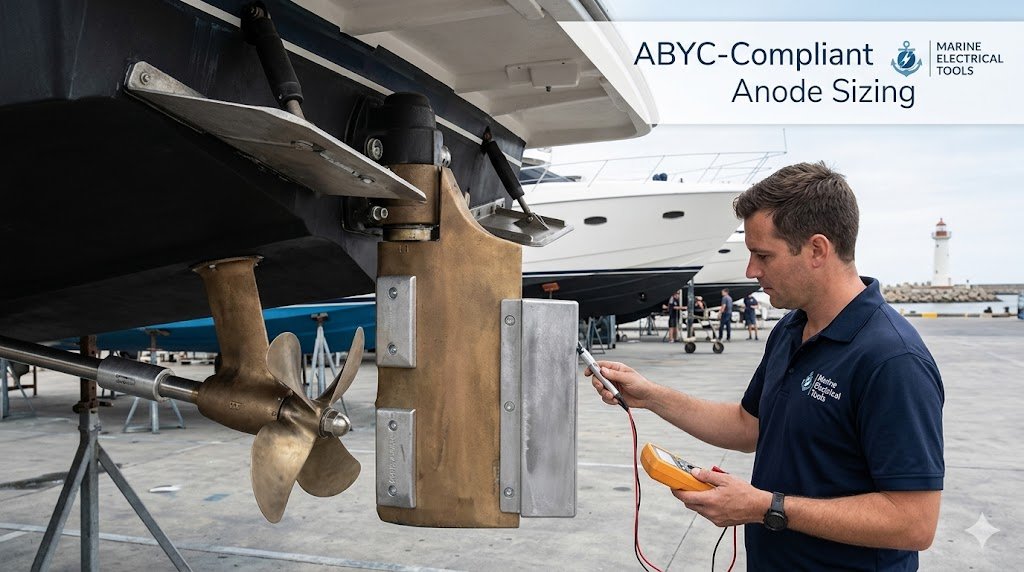
When installing new anodes, never paint the surface of the anode or the contact point on the shaft or hull. Paint acts as an insulator, effectively “turning off” the galvanic protection. If you are replacing a bolt-on hull anode, use a wire brush to clean the mounting studs until they are bright and shiny. I also recommend using a multimeter to check for continuity between the anode and the bonded metal—it should be nearly zero ohms.
Monitoring Anode Consumption Rates
A common question boaters ask after using an Anode Calculator is: “How fast should these disappear?” Ideally, your anodes should be approximately 50% consumed at the end of your boating season. If you haul out and find your anodes looking brand new, they are likely not “electrically connected” to the boat or you have used the wrong material for your water type.
Conversely, if your anodes are completely gone in three months, you likely have a “stray current” issue. This often occurs in crowded marinas where a nearby vessel has a DC grounding fault. In these cases, the Anode Calculator results may need to be doubled, and a thorough corrosion survey using a silver/silver-chloride reference electrode is recommended to identify the source of the leak.
Environmental Impact and Sustainable Boating
Choosing the right metal via our Anode Calculator also has environmental implications. While Zinc has been the marine standard for decades, it contains trace amounts of Cadmium, a heavy metal that can be toxic to marine life in high concentrations.
Modern Aluminum anodes (specifically Mil-Spec A-24779) are not only lighter and more effective across a wider range of salinities, but they are also considered a “greener” alternative. Aluminum anodes last longer and provide a higher driving voltage, making them the “Best #1” choice for the majority of modern fiberglass and aluminum vessels. By optimizing your anode weight, you reduce the amount of metal byproduct released into the local watershed. I always encourage my readers to make the switch to Aluminum—it’s better for the boat and better for the water we love.
The Anode Calculator is a critical tool because, as I always say, you’re either paying for the right anodes now or a new set of props later! It’s the ultimate defense against the “hungry” electrical currents that want to eat your boat.
Please refer to these other helpful tools related to Anodes!
- Shore Power Load Calculator – This is a vital connection. Being plugged into a dock links your boat to every other vessel on the pier. This tool helps users audit their AC system, which is where many “stray current” corrosion issues begin.
- Marine Wire Gauge Calculator – Proper bonding is key to corrosion protection. If the wires connecting your anodes to your underwater metals are too small or corroded, the protection won’t work. This tool ensures those “electrical paths” are solid.
- Marine Battery Bank Size Calculator (ABYC Compliant) – A healthy DC system starts with a properly sized bank. Since many corrosion issues are caused by DC ground faults, having a clean, ABYC-compliant battery setup is your first line of defense.
- Marine Voyage Power & Range Calculator – For those who spend long periods away from the dock, understanding your power burn helps you manage your systems better, reducing the time you’re reliant on shore power and its associated corrosion risks.