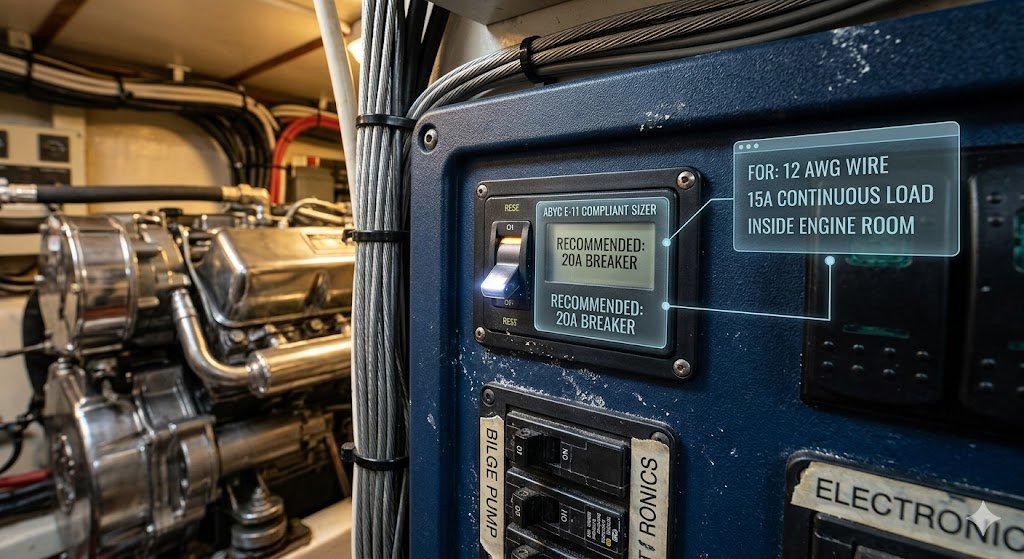
Nothing ruins a perfect sunset cruise faster than the smell of melting insulation and the sudden realization that your boat is trying to become a Viking funeral pyre. Honestly, using a Marine Circuit Breaker Size Calculator is the single most reliable way I’ve found to keep the “smoke in the wires” where it belongs. Accurate 12V DC breaker sizing isn’t just about following the rules; it’s the frontline defense against electrical fires.
This ABYC circuit breaker calculator ensures your overcurrent protection is perfectly matched to your wire’s ampacity, keeping things safe and compliant for you, your guests, and anyone else you’ve managed to talk into coming aboard. Whether you’re a pro tech or a weekend DIYer, getting that breaker size right is the difference between a reliable offshore system and an unplanned swimming lesson.
Input Your Data In the Circuit Breaker Size Calculator
Quick Navigation
Table of Contents
Circuit Breaker Sizer
3. How long will it run at once?
Common Device Amp Draw (12V DC)
Use these typical values if you don’t have your device manual handy:
| Marine Device | Typical Amps |
|---|---|
| LED Cabin Light | 0.5A – 1.0A |
| Chartplotter / GPS | 2.0A – 4.0A |
| VHF Radio (Transmit) | 5.0A – 6.0A |
| Bilge Pump (Small) | 3.0A – 5.0A |
| Marine Refrigerator | 4.0A – 6.0A |
| Electric Windlass | 80A – 120A |
Help us continue building valuable tools with a small donation.
Based on ABYC E-11 Overcurrent Protection Rules
This tool uses official ABYC guidelines for selecting the correct breaker or fuse rating. I have found, that in the marine environment, vibrations, moisture, and heat make precise overcurrent protection a requirement, not a suggestion.
Rule #1: Breakers Protect the Wire, Not the Device
A common misconception is that a breaker protects your electronics. In reality, this ABYC circuit breaker calculator is designed to help you protect the wire. By tripping before the conductor reaches its maximum heat capacity, the breaker ensures the insulation never melts. i have seen this happen on more than one occasion.
I’ve crawled into enough engine rooms to know exactly what happens when this rule is ignored. There’s nothing quite like the sight of a 12AWG wire that’s been cooked until the insulation looks like charred spaghetti because someone thought the breaker was there to protect the bilge pump rather than the wire itself. Following these marine electrical safety protocols is the only way to prevent onboard fire hazards.
Accounting for Continuous vs. Intermittent Loads
Not all electrical loads are equal. Continuous loads (like refrigeration or cabin lights) generate constant heat in the wire, requiring a higher safety margin. Intermittent loads (like a horn or windlass) run for short bursts, allowing for different sizing criteria.
How to Use the ABYC Circuit Breaker Size Calculator Tool
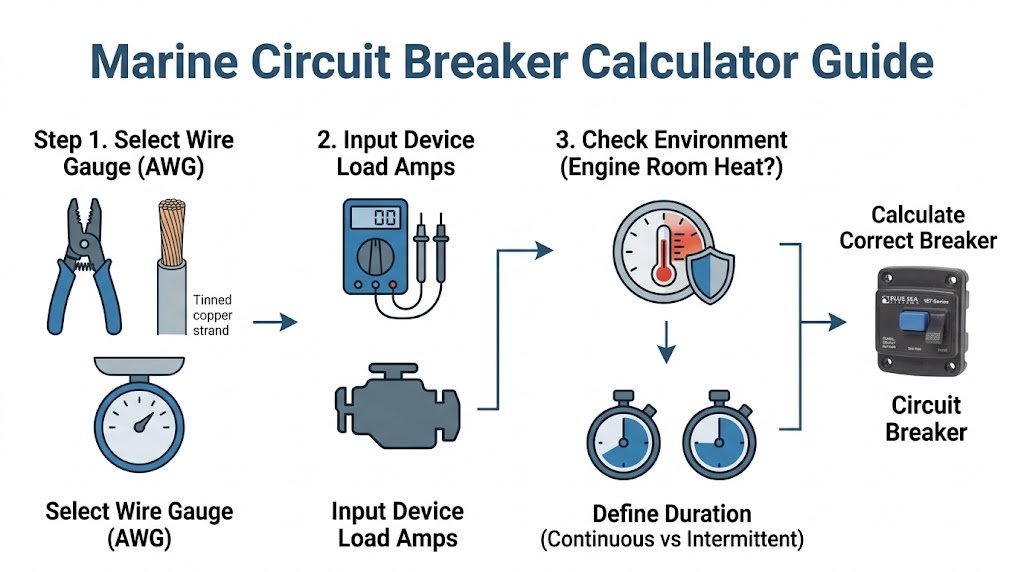
Step 1: Select Wire Gauge (AWG): Choose the size of the tinned copper wire used in the circuit. If you haven’t run wire yet, use our Marine Wire Gauge Calculator first.
Step 2: Enter Maximum Current (Amps): Input the device’s maximum current draw. If you aren’t sure, refer to the “Common Device” table above.
Step 3: Choose Load Duration: Select “Continuous” for anything running longer than 15 minutes.
Step 4: Review Your Result: The calculator will provide the recommended breaker size that protects your wire while supporting your equipment.
Example Calculation: Sizing a Water Pump
The Scenario:
Wire: 12 AWG Tinned Copper
Load: 15A Fresh Water Pump
Environment: Outside Engine Room
Duration: Continuous (runs during showers/washdown)
The Result:
Per ABYC rules, a continuous load needs a 125% safety margin ($15A \times 1.25 = 18.75A$). The calculator recommends a 20A breaker, which is the next standard size up that remains safely below the 12 AWG wire’s ampacity limit.
ABYC Standards Reference Guide
The 125% Rule for Continuous Loads
ABYC E-11 requires that for any load expected to run for more than 15 minutes, the overcurrent protection device must be rated at no less than 125% of the continuous current. ABYC wants that 125% safety margin because they know that wires, much like myself after a long day in the sun, don’t perform quite as well when they’re overheating.
Wire Ampacity & Temperature Derating
| Wire Size (AWG) | Outside Engine Room | Inside Engine Room (85%) |
|---|---|---|
| 16 AWG | 25A | 21.2A |
| 14 AWG | 35A | 29.7A |
| 12 AWG | 45A | 38.2A |
| 10 AWG | 60A | 51A |
This tool assumes the use of 105°C tinned copper marine-grade wire. If your wire passes through an engine room, the Circuit Breaker Size Calculator tool automatically applies a 15% derating factor to account for the ambient heat, as required by ABYC Table VI-A.
Common Questions About Overcurrent Protection
What does a circuit breaker actually protect?
A circuit breaker is designed to protect the conductors (wires) in a circuit. It stops the flow of electricity if the current exceeds the wire’s safe limit, preventing the wire from becoming a heating element. Using the Circuit Breaker Size Calculator can help you mitigate these potential problems.
Can I “upsize” a breaker if it keeps tripping?
No. Never install a larger breaker without first upgrading the wire gauge. I have done this in the past personally, when I was new to the industry. Look, I’ll be the first to admit it: back when I was just starting out and a breaker kept tripping, my first instinct was to just swap it for a bigger one. It’s a classic rookie mistake.
But here’s the reality: if that breaker is tripping, it’s literally screaming at you that something is wrong. Upsizing the breaker without upgrading the wire is basically like turning up the radio so you don’t hear your engine knocking. If a breaker trips, it is either doing its job of protecting an undersized wire or signaling a fault in the device.
Does this calculator work for AC Shore Power?
No. This tool is designed specifically for DC Marine Circuits (12V/24V). Shore power systems have different grounding and interrupt capacity requirements.
A common debate is boat fuse vs breaker; while both protect the wire, breakers allow for easy resetting without carrying spare parts.
Marine Electrical Safety Notes
Always use Marine-Grade: Only use breakers that are “Ignition Protected” if they are installed in gasoline engine or battery spaces.
Check for Corrosion: A corroded connection creates resistance and heat, which can cause a breaker to trip even if the load is “safe.” I make it a habit to do a ‘heat feel’ test on my connections once a month. If a connection feels warm to the touch while under load, you’ve got high resistance—usually from corrosion—and that’s a trip waiting to happen. It takes five minutes and can save you a whole lot of troubleshooting later.
Follow the Weakest Link: Your breaker must always be the “weakest link” in the chain to ensure it fails before the wire does.
Maintaining marine electrical safety requires regular inspections of your connections for corrosion.
When you’re working on your boat’s electrical system, it’s easy to get caught up in just one part of the puzzle. But remember, things like wire gauge and circuit breakers are a team—the wire handles the flow, but the breaker is the ‘safety guard’ that makes sure that flow never gets dangerous. To help you get the whole system dialed in safely, I’ve put together a few other tools that work hand-in-hand with your breaker calculations:
- Shore Power Load Calculator – This is a great starting point to see your total AC demand so you can pick the right shore power service and main breakers without any guesswork.
- Marine Inverter Size Calculator (ABYC Compliant) – If you’re adding an inverter, this helps you size those heavy-duty DC fuses and breakers that keep high-power circuits safe.
- Marine Wire Gauge Calculator (ABYC Aligned) – I always recommend using this first! You need to know your wire size before you can pick the right breaker to protect it.
- Battery Charger Size Calculator – Perfect for making sure your charging system is balanced and has the right protection on both the AC and DC sides.
Using these together is the best way to make sure your boat is efficient, reliable, and—most importantly—safe for you and your crew.
Need Another Tool?
Back to our full suite of ABYC-compliant marine electrical calculators.
View All Marine Tools →