Quick Navigation
Table of Contents
This Marine Generator Size Calculator helps you determine the correct generator wattage for your vessel based on AC appliance loads, inverter-charger demand, and battery charging requirements. By following ABYC-aligned standards, this tool ensures your marine generator is sized for safety and reliability in harsh salt-air conditions.
Can’t find the Watts? Simply multiply Volts x Amps on your appliance’s sticker to get the total wattage.
Input Your Data Below:
Marine Generator Sizing Advisor
Enter your expected AC loads to see ABYC-aligned generator recommendations…
Let’s be honest: there is a specific kind of “boat stress” that only happens at 2:00 AM when the air conditioning kicks on, the water heater cycles, and suddenly everything goes pitch black because you tripped the main breaker. It’s usually followed by a long, dark walk to the lazarette in your pajamas. I’ve been there, and it’s exactly why I built this tool.
In the world of marine electrical systems, “guesstimating” your power needs is a recipe for a bad weekend. We aren’t just looking for a generator that barely gets the job done, we’re looking for a setup that handles those massive startup surges without breaking a sweat. Whether you’re running a small portable unit for a weekend getaway or a massive diesel plant for a long-range trawler, the math remains the same.
By using the logic found in our Marine Inverter Size Calculator alongside this generator guide, you’re ensuring that your boat’s “heartbeat” stays strong. We’ve factored in everything from the “inrush current” of your fridge to the steady pull of your battery chargers, so you can spend more time enjoying the sunset and less time playing “electrical detective” with a multimeter.
⚓ The Shore Power Paradox
Why does my generator need to be bigger than my shore power plug?
It’s a common question! Most boats have a 30A or 50A shore power limit. However, AC appliances (like your Air Conditioner) require a massive Surge of power just to start up. While your shore power pedestal can often “absorb” that spike, a generator cannot—it must be sized to handle that peak moment.
Remember: Your generator size is about starting your loads; your shore power limit is about managing them. If the calculator warns of an “Infrastructure Limit,” simply practice Load Shedding at the dock, and enjoy full power at sea!
How to Use a Generator Size Calculator for Your Boat
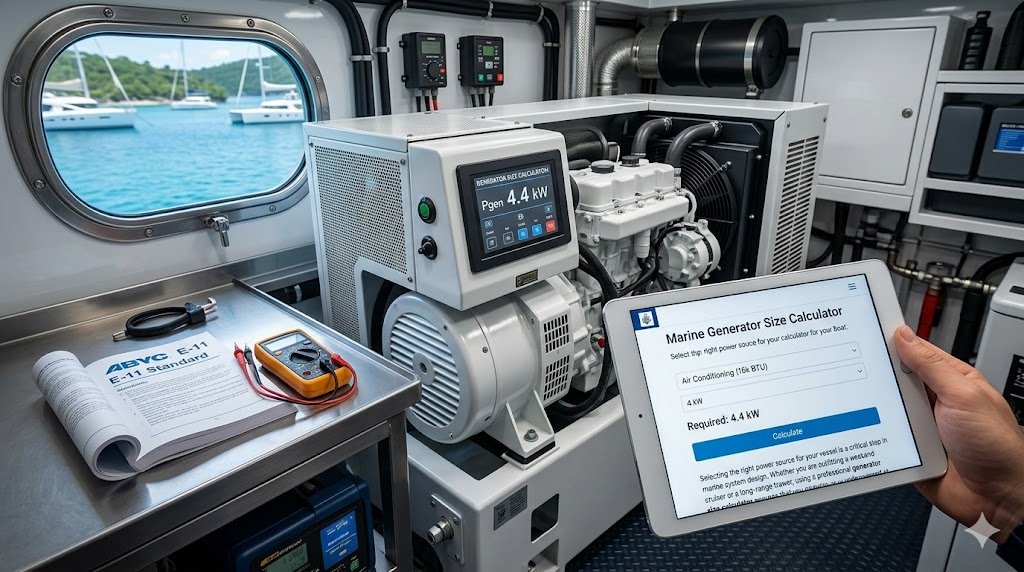
Selecting the right power source for your vessel is a critical step in marine system design. Whether you are outfitting a weekend cruiser or a long-range trawler, using a professional generator size calculator ensures that you don’t end up underpowered at sea or suffer from engine damage due to underloading.
This guide explores how to calculate your total AC requirements, account for startup surges, and follow ABYC E-11 standards for a safe, reliable installation.
Why You Need a Marine Generator Size Calculator
Many boaters make the mistake of simply adding up the labels on their appliances. However, a “one-to-one” addition doesn’t account for the complex electrical environment of a boat. A dedicated generator size calculator is essential because it factors in the 80% continuous load rule and the massive “inrush current” required by motors.
Operating a generator at 100% capacity is like driving your truck with the engine redlined all the way from Florida to Maine. Sure, it can do it, but you’ll be a nervous wreck waiting for something to snap. That 20% buffer the calculator provides is your “sleep easy” insurance. It handles the unexpected—like someone turning on a hair dryer while the AC is humming—without plunging the boat into total darkness.
Without an accurate generator size calculator, you risk “Wet Stacking”—a condition where a diesel generator runs too cool because the load is too light, leading to carbon buildup and permanent engine damage. Conversely, an undersized unit will stall the moment your air conditioner tries to kick in.
Look, I get the temptation to grab a cheap portable unit from a big-box store, but salt air is a brutal critic. Beyond the rust, there’s the issue of “Wet Stacking.” I’ve seen $10,000 diesel generators die early because they were too “bored.” If a generator doesn’t run with enough load to get hot, it develops carbon crust that ruins the engine. We aren’t just sizing for power; we’re sizing for the longevity of your investment.
Calculating Total AC Loads and Peak Demand
To get the most out of your generator size calculator, you must identify every AC appliance that might run simultaneously. On a typical vessel, this includes your climate control, galley appliances, and the often-overlooked battery charging system.
Understanding Running Watts vs. Surge Watts
When inputting data into a generator size calculator, there are two numbers to keep in mind:
- Running Watts: The power an appliance uses while operating normally.
- Surge Watts (Startup): The momentary spike (often 2-3 times higher) required to start a motor.
For example, a standard 16,000 BTU marine air conditioner might run at 1,500 Watts but require a 3,500-Watt surge to start the compressor. Think of “Surge Watts” like trying to push a stalled car. It takes a massive burst of energy to get the tires moving, but once you’re rolling, it’s easy to keep it moving.
Your AC compressor is that stalled car. If your generator doesn’t have the “leg strength” to get that compressor over the hump, the whole system collapses, usually at 2 AM when you need the cooling most. A world-class generator size calculator automatically accounts for this peak to ensure your generator doesn’t trip its breaker.
The Role of the Inverter-Charger in Generator Sizing
Your battery charger is often the largest single load on your generator. If you have a large lithium or AGM bank, your charger might pull 2,000 to 3,000 Watts just to replenish the batteries. When using the generator size calculator, always ensure you include the “Bulk Charge” rate of your Marine Inverter Size Calculator results to avoid overloading the system.
ABYC Standards for Marine Generator Installation
Safety is the most important factor in marine electricity. The American Boat & Yacht Council (ABYC) provides the framework for how generators should be integrated into a boat’s grid. A high-quality generator size calculator follows these guidelines to keep your insurance valid and your crew safe.
The 80% Rule for Continuous Operation
ABYC standards suggest that a generator should not be operated at 100% of its rated capacity for more than brief periods. Our generator size calculator builds in a 20% safety margin. If your total load is 4kW, the calculator will recommend a 5kW unit. This overhead allows the generator to run cooler, last longer, and handle small unexpected loads without a total system shutdown.
Managing Infrastructure and Load Shedding
One common “Newbie” mistake is installing a generator that is too powerful for the boat’s existing wiring. If your generator size calculator shows a result higher than 30 Amps (for a 30A boat), you must practice Load Shedding. This means manually managing which appliances are on. You might turn off the water heater for 20 minutes while you use the microwave and the stovetop. For more precision on your boat’s limits, consult our Shore Power Load Calculator.
Choosing the right generator is all about making sure you can run your “big” comforts—like the A/C or the water heater—without that annoying ‘thump’ of a breaker tripping just when you’re getting settled. It’s about finding that sweet spot where you have enough power for the “startup surge” of your motors, but you’re not lugging around more weight (and noise!) than you actually need.
To help you build a generator setup that’s as quiet and efficient as possible, here are the tools that work alongside your generator calculations, as well as shore power load above:
- Marine Inverter Size Calculator (ABYC Compliant) – If you’re planning to use your generator to charge batteries while also running appliances, this tool helps you understand the total load on the system. It also accounts for that critical 125% motor surge buffer.
- Battery Charger Size Calculator – One of the main jobs for a generator is “bulk charging” your batteries. This tool helps you size a charger that can take full advantage of your generator’s output, so you can get the batteries topped off and turn the generator off sooner!
- Marine Wire Gauge Calculator – Even with a generator, you need the right “pipes” to move that power. Use this to ensure your AC and DC wiring can handle the current without overheating.
By matching your generator to your actual daily loads and charging needs, you’re creating a system that’s reliable, fuel-efficient, and—most importantly—quiet enough to let you enjoy the cove.
Troubleshooting Common Sizing Mistakes
If your generator size calculator gives you a result that seems too high or too low, double-check your inputs. Ensure you haven’t confused “Amps” with “Watts.” Remember the formula: Volts x Amps = Watts.
By utilizing this generator size calculator, you are taking the guesswork out of your marine electrical system. Whether you are choosing between a Fischer Panda, Northern Lights, or a portable unit, having the math backed by ABYC-aligned logic is the only way to ensure “Blue Water” reliability.
One final tip from the trenches: don’t forget about “Engine Room Fever.” If you’re cruising in the tropics, a 95°F engine room suffocates a generator’s efficiency. I’ve had clients call me frustrated that their gear was “acting up” in the Bahamas, only to find the unit was simply starving for cool air. If you’re planning on heavy tropical use, that 20% safety margin we calculated is your best friend.
Explore more ABYC-aligned calculators & guides.