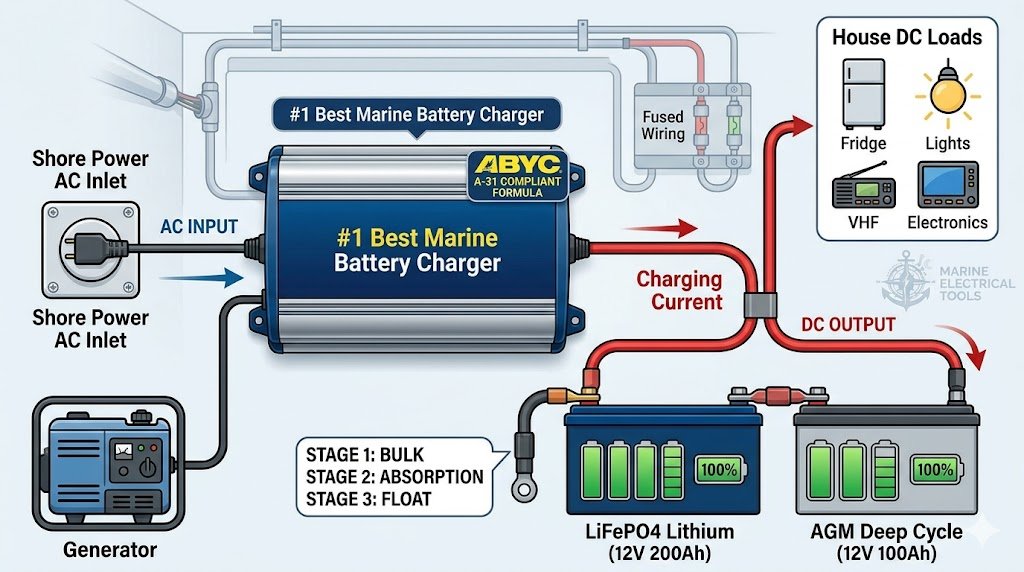
This Marine Battery Charger Size Calculator helps you determine the correct charger amperage for your boat based on battery bank size, chemistry, charging stages, and recommended charge rates. It follows ABYC‑aligned best practices to ensure your batteries charge safely, efficiently, and with maximum lifespan.
Quick Navigation
Table of Contents
Input Your Data Below
Marine Battery Charger Size Calculator (ABYC-Aligned)
Selecting the right charger is the difference between a battery bank that lasts ten years and one that ends up as an expensive boat anchor in two. I’ve seen it a thousand times: someone spends $3,000 on a fancy new Lithium bank and then tries to charge it with a “dumb” charger they found in their garage from 1994.
This Marine Battery Charger Size Calculator is here to save you from that headache. I designed this tool to help boat owners, fellow techs, and weekend warriors determine the exact amperage needed to stay powered up without frying their gear. By using industry-standard formulas aligned with ABYC (American Boat and Yacht Council) safety standards, we’re taking the “guess and pray” method out of your electrical system design.
Why Using a Battery Charger Size Calculator is Critical
Many boaters live by the philosophy that “more is always better.” While that might be true for horsepower or ice-cold drinks, pushing too much current into a battery is a recipe for disaster. If you hammer a lead-acid battery with too many amps, you get excessive heat and off-gassing (which smells like rotten eggs and regret). On the flip side, Lithium (LiFePO4) systems might seem tough, but internal cell damage from over-aggressive charging is a real and very expensive risk.
Conversely, being “under-propped” with your charger is just as bad. An undersized charger might never actually reach the “Absorption” stage. Instead of a full charge, your batteries just sit there in a state of partial discharge, leading to sulfation in traditional batteries—which is basically a slow death sentence for your power bank. My Battery Charger Size Calculator finds that “Goldilocks” zone where your batteries are happy, cool, and fully charged.
How to Calculate Marine Battery Charger Amperage
To use the Battery Charger Size Calculator effectively, you need to understand the three primary variables that dictate your charging needs. It’s not just about the size of the box; it’s about how much “juice” your chemistry can actually handle.
1. Battery Chemistry and C-Rate
Different battery types have different internal resistances and thermal limits. You can’t treat a Flooded Lead Acid (FLA) battery like a high-performance Lithium cell.
- Flooded Lead Acid (FLA) & AGM: These are generally limited to a 20% charge rate (0.20C). If you have a 100Ah bank, don’t try to shove more than 20 Amps into it. It’s like trying to drink from a firehose—eventually, things are going to get messy.
- Gel Batteries: These have a bit more “push back” (resistance), which often limits them to a 25% rate (0.25C).
- Lithium (LiFePO4): These are the overachievers of the marine world. They can often handle 50% (0.50C) or even 100% of their capacity in charge current. However, in my experience, keeping it at 50% is the secret sauce for making those batteries last for a decade or more.
2. Depth of Discharge (DoD)
The “emptier” your battery is, the more Amp-hours (Ah) need to be replaced. If you have a 400Ah bank and you’ve run it down to 50%, you’ve got a 200Ah hole to fill. My Battery Charger Size Calculator uses this to estimate your recovery time. Because let’s be honest: nobody wants to spend their entire Saturday at the dock listening to the hum of a charger or the drone of a generator just so they can run the fridge overnight.
3. Constant DC Loads (The “Hidden” Variable)
This is the “gotcha” moment where most basic calculators fail. Imagine you’re at the dock. You’ve got the 12V fridge humming (5A), the LED lights on for dinner (2A), and the VHF radio scanning (1A). That’s 8 Amps of current being diverted away from your batteries.
If you bought a 20A charger based on a simple chart, only 12A is actually making it into your batteries. At that rate, you’ll be charging until next Tuesday. Our tool lets you input these Running DC Loads so your charger is sized to handle the house loads plus the battery replenishment.
ABYC Standards for Marine Battery Chargers
According to ABYC A-31 standards, your charger has to be capable of hitting 100% within a reasonable timeframe without turning your battery into a space heater.
Safety isn’t just a suggestion here. High-output chargers (anything over 150 Amps) are basically industrial power plants. They require specialized fuse protection and heavy-gauge marine wire to prevent your engine room from becoming a bonfire. I always tell folks: if your charger wires are getting hot enough to cook a steak on, you’ve done something wrong. Make sure to consult our Marine Wire Gauge Calculator to ensure your cables can actually handle the heat. For those who want the “deep dive” on how to wire these systems like a pro, Victron Energy – Wiring Unlimited is basically the Bible of marine DC design.
Frequently Asked Questions
Can I use a car charger on my boat?
Short answer: No. Long answer: Absolutely not. Automotive chargers are built for garages, not the salty, humid, vibrating environment of a boat bilge. Most importantly, they aren’t “ignition protected.” If you have a gas engine and a spark-prone car charger, you’re essentially sitting on a giant orange flare. Plus, marine chargers use multi-stage logic (Bulk, Absorption, Float) that a cheap car charger simply doesn’t have.
What is the 10% to 25% rule?
This is the “old guard” rule for lead-acid batteries. The idea was to keep the charger between 10% and 25% of the total bank capacity to prevent the plates from warping. With modern Lithium banks, we basically threw this rule out the window in favor of “as fast as the BMS allows,” but for most of us, staying in that 25-50% range is still the safest bet for longevity.
How do I calculate charge time?
The math isn’t too scary: (Ah to Replace ÷ Net Charger Amps) × 1.15 Efficiency Factor
I add that 15% buffer because chargers don’t run at full tilt the whole time. As the battery gets “full,” it starts to resist the current, and the charger has to taper off. It’s like trying to pack the last few items into a suitcase—the closer you get to finished, the slower it goes.
Summary: Optimizing Your Marine Power System
Using this Battery Charger Size Calculator is your first step toward true off-grid freedom. When you match your charger to your chemistry and account for your actual daily consumption, you get faster recovery times and a battery bank that won’t give up on you in the middle of the night.
If you’re doing a full system overhaul, don’t stop here. You should pair this with our Battery Bank Size Calculator to make sure your “bucket” is big enough, and check out the Solar Charging Calculator if you’re looking to cut the shore power cord for good.